
A colourful paper kite rises above a rooftop, turns sharply in the wind, and approaches its rival. Below, the flyer carefully pulls and releases the string, waiting for the right moment. Within seconds, one kite breaks free and drifts away. This simple contest captures the excitement of fighter kites—a tradition that combines craftsmanship, skill, competition, and community celebration.
The history of fighter kites stretches across cultures and continents. Although their precise birthplace remains uncertain, their development belongs to the wider story of kite flying: an ancient practice that different societies transformed into their own distinctive aerial sport.
The earliest written traditions of kite flying are associated with China, more than two thousand years ago. Historical accounts describe kites used for military purposes, including measuring distances and communicating information. Over centuries, traders and travellers helped spread kite flying across Asia, reaching Korea, India, and the Middle East. These accounts establish the antiquity of kites, but they do not identify a universally accepted date or inventor of kite fighting.
What made the fighter kite distinctive was its responsiveness. Many traditional fighters are lightweight, single-line kites designed with enough instability to turn quickly. By adjusting the tension of the line, a skilled flyer can make the kite spin, dive, or change direction. In many regional traditions, the aim is to cut an opponent’s line; in others, victory comes through entangling, grounding, or outmanoeuvring the opposing kite.
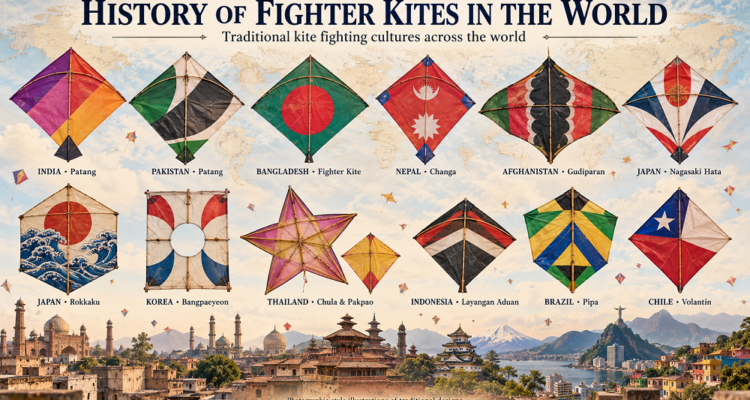
India became one of the great centres of this tradition. The exact route by which kites arrived remains debated, with explanations involving contact with China and travel through Persia. References to paper kites appear in medieval Indian poetry, including the work of the thirteenth-century Marathi poet Namdev. During the Mughal period, kite flying gained prominence as a competitive pastime among the nobility. Historical writing about Lucknow also describes fighting kites in the eighteenth century, showing how deeply the sport became embedded in urban culture.
The Indian patang, commonly made from paper stretched over a light bamboo framework, became closely associated with rooftop battles. Traditionally, competitors used manja or manjha, an abrasive-coated line intended to cut a rival’s string. In Gujarat, Uttarayan developed into a major community celebration, bringing families and neighbours together on terraces. Ahmedabad’s kite markets, skilled makers, and enthusiastic flyers became central to this culture. Since 1989, the city’s International Kite Festival has also provided a meeting place for kite makers and flyers from around the world.
Across South Asia, kite fighting acquired different local identities. Pakistan developed a strong patang tradition, while Bangladesh and Nepal cultivated their own competitive styles. In Nepal, kites known as changa are associated particularly with the Dashain season. These traditions share an enthusiasm for aerial competition while differing in kite designs, vocabulary, seasonal customs, and methods of flying.
Afghanistan developed another celebrated kite-fighting culture, especially in Kabul. Historical reporting describes paper-and-bamboo kites flown by pairs: one person controlling the kite while another manages the line. Below the contests, kite runners pursue the defeated kites drifting towards the ground. The tradition also experienced political interruption: kite flying was banned under the Taliban after they took Kabul in 1996 and reappeared publicly following their removal in 2001. This history made the kite a powerful image of childhood, recreation, and the recovery of public life.
Japan developed several distinctive forms of kite combat. Nagasaki’s colourful hata kites are linked, according to local tradition, to Indonesians who accompanied Dutch traders to Dejima. The city’s kite battles date back to the Edo period. Japan also produced the six-sided rokkaku, a larger fighting kite that can be flown by individuals or teams. Together, these designs show how kite fighting adapted to both maritime cultural exchange and local festival traditions.
Korea’s bangpaeyeon, or shield kite, represents another important regional design. Its quick movement makes it well suited to aerial competition. Korean kite flying also belongs to the country’s New Year folk traditions, connecting competitive play with seasonal celebration. In Thailand, the well-known chula and pakpao represent a different style of contest: teams attempt to capture and draw an opposing kite into their own area. Kite fighting therefore includes several forms of tactical play beyond cutting strings.
The tradition extends beyond Asia. Brazil’s pipas and Chile’s volantines belong to established kite-fighting cultures in Latin America. Their presence demonstrates the worldwide appeal of an activity that requires relatively simple equipment but rewards considerable skill. However, the spread of kite fighting should not be reduced to one neatly documented journey from a single country to every other region; its history contains gaps, overlapping influences, and local adaptations.
Modern enthusiasts continue to develop the sport. Contemporary materials have expanded the possibilities of fighter-kite construction, while North American flyers have formalised games such as line touch. In this format, competitors earn points by touching an opponent’s flying line from a designated direction, preserving the challenge of precise aerial control.
The enduring appeal of fighter kites lies in the relationship between maker, flyer, and wind. Each kite carries the knowledge of the hands that shaped it and the judgement of the person controlling it. From South Asian rooftops to Japanese festival grounds and Latin American neighbourhoods, fighter kites tell a shared human story: how a small object, lifted by the wind, can become a source of artistry, rivalry, friendship, and cultural pride.