
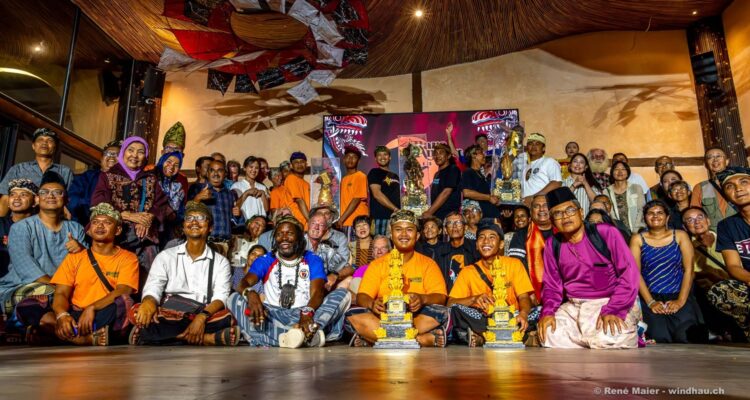
BALI, Indonesia (July 2026): The skies above Mertasari Beach in Sanur came alive with thousands of colorful kites as the Rare Angon International Kite Festival 2026 was successfully held from July 23 to 26, attracting traditional Balinese kite teams and international kite flyers from across the globe.
Recognized as one of Bali’s largest cultural and tourism events, the four-day festival featured more than 1,000 traditional Balinese kites and 105 international kites flown by participants from 23 countries, including Australia, Austria, Germany, India, Thailand, the Philippines, and several other nations.
The festival opened with spectacular daytime flying sessions where giant traditional Balinese kites, measuring up to 25 metres in length and nearly 20 metres in width, dominated the skyline. Their impressive craftsmanship and graceful flight captivated thousands of visitors gathered along the beach.
One of the festival’s highlights was the Night Kite Flying Show, where beautifully illuminated kites equipped with LED lighting created a breathtaking display against the evening sky. The night programme was complemented by live cultural performances and music, providing visitors with a memorable festival experience.
Traditional Balinese kite competitions were held throughout the final two days, while international kite flyers showcased creative and artistic designs at Muntig Siokan Beach in Sanur. Participants displayed imaginative kites inspired by wildlife, mythology, cartoon characters, fruits, and religious symbols, demonstrating the diversity of modern kite art.
Despite the international participation, the festival remained deeply rooted in Balinese tradition. Three iconic kite categories—Bebean (fish-shaped), Pecukan (oval-shaped), and Janggan (dragon kite)—formed the centrepiece of the local competitions.
Among them, the Janggan kite remains the most revered. Representing Basuki, the mythical cosmic dragon in Balinese Hindu tradition, the giant kite features an exceptionally long tail that can extend beyond 100 metres. Before being flown, the Janggan traditionally undergoes a sacred blessing ceremony, reflecting its spiritual significance in Balinese culture.
The festival derives its name from Sang Hyang Rare Angon, a manifestation of Lord Shiva, who is traditionally portrayed as a young shepherd capable of summoning the wind through the music of a magical flute. This legend has long symbolized Bali’s centuries-old kite-flying heritage and its close connection with nature and spirituality.
Historically, kite flying in Bali was also associated with agriculture, as farmers believed that flying kites during harvest season helped protect rice fields by keeping birds away from crops. The tradition continues to be celebrated today as an important expression of Balinese identity and cultural preservation.
More than a sporting event, the Rare Angon International Kite Festival has become a major platform for cultural exchange and tourism promotion. By bringing together local traditions with international creativity, the festival continues to strengthen Bali’s reputation as one of the world’s premier destinations for kite festivals while preserving its unique cultural heritage for future generations.